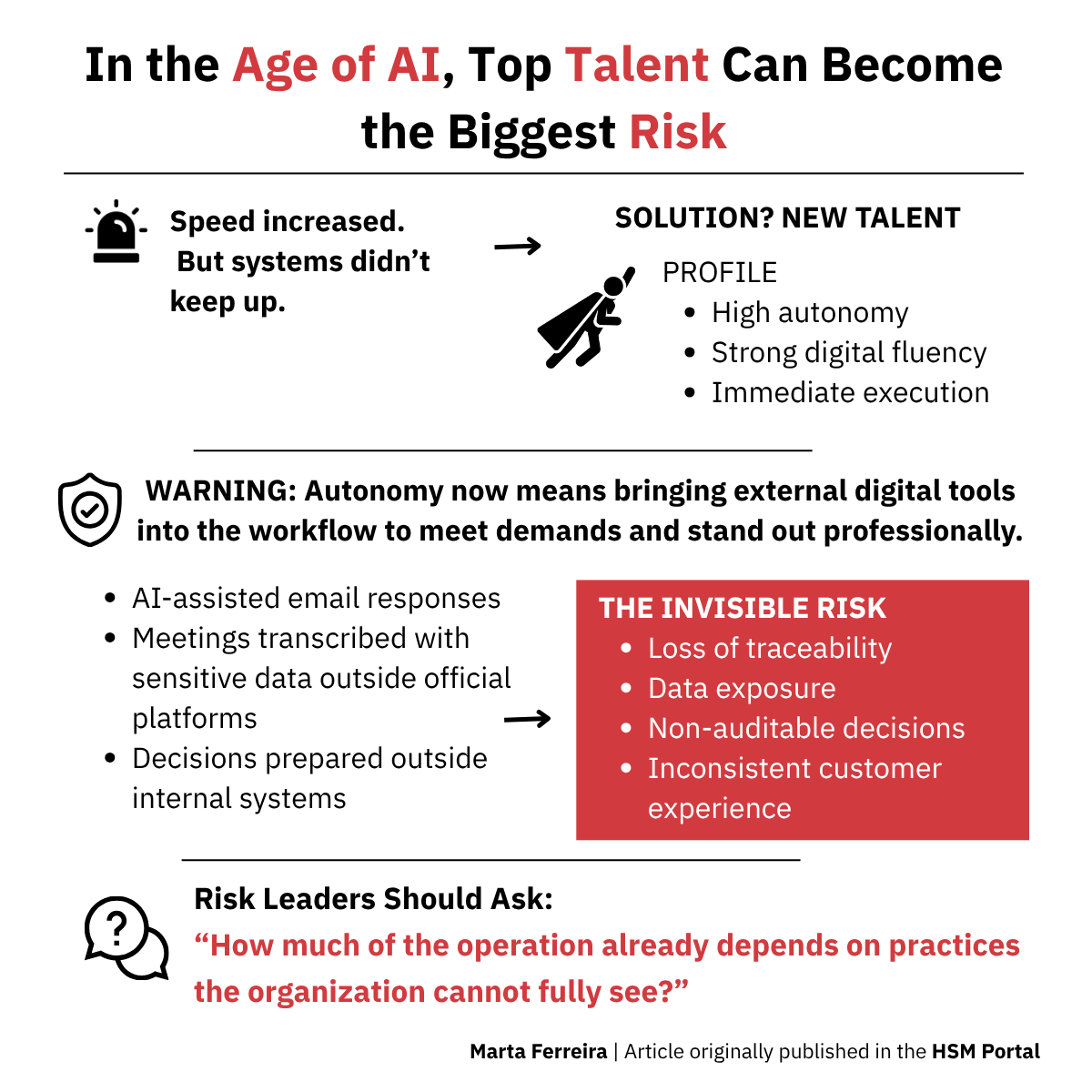
Artificial intelligence is changing more than productivity.
It is changing where work happens, how decisions are made, and how organizations lose control without realizing it.
This article explores how the combination of pressure for speed, highly autonomous talent, and the informal adoption of AI tools is pushing execution outside formal systems, creating operational risks that traditional performance indicators rarely detect.

The Pressure for Speed Is Real
Organizations today operate under constant acceleration. Competition is more intense. Customers have more choices and less patience. Marketing campaigns create sudden spikes in demand. SLAs leave little room for failure. Businesses are expected to deliver more, with higher quality, in less time.
The result is predictable: companies need people who can produce impact immediately.
And that is changing the type of talent organizations prioritize. Across industries, companies are increasingly hiring professionals who can operate autonomously from day one: individuals with high digital fluency, strong adaptability, and the ability to execute quickly with minimal onboarding.
These professionals move fast. Often faster than the systems around them were designed to support.
When Execution No Longer Fits the System
What I have observed across different environments is a growing mismatch between the speed of modern talent and the operational design of the organizations they join.
Over the years, companies have added layer after layer of structure to their operations: approval flows, compliance checkpoints, audit requirements, validation rules, governance processes, security controls, and increasingly complex systems.
Each addition was introduced for legitimate reasons: to reduce risk, ensure consistency, protect customers, and maintain regulatory compliance.
But every additional layer creates friction. The result is an operational environment that performs well under stability, yet struggles under rapid shifts in demand, volume, or execution pressure. Systems designed to maximize control rarely optimize for speed.
To compensate, organizations recruit highly autonomous professionals capable of accelerating delivery wherever possible.
But the organization often makes a critical assumption: that the system itself will absorb that speed. In practice, it usually does not. Instead, execution begins migrating outside formal workflows. And this is where AI stops being an innovation topic and becomes operational infrastructure.
The Rise of Invisible Operations
According to Microsoft and LinkedIn research, approximately 75% of knowledge workers already use AI in their daily work, and more than half rely on personal AI tools outside corporate environments. In Brazil, adoption rates are even higher.
The implications are operational, not theoretical: customer communications are drafted with ChatGPT to improve speed and clarity; meetings are recorded and automatically summarized through tools like Otter.ai or Fireflies.ai; internal analyses are reorganized through prompts, temporary documents, spreadsheets, and lightweight automations that exist entirely outside official systems.
None of this happens because employees are intentionally bypassing process, it happens because these tools are effective: they remove friction, they accelerate execution, they help people meet expectations the formal system itself often cannot support.
And that is precisely where the risk begins. To maintain speed, work increasingly takes place in environments that were never designed for governance, traceability, or data protection.
Over time, organizations lose visibility into fundamental questions:
- Where was this decision made?
- Which information was used?
- Which system contains the record?
- Which version is correct?
- Who validated the output?
As execution spreads across unofficial channels, parts of the operation become progressively less auditable.
The issue is not that people stop working within the system entirely. The issue is that critical parts of execution start happening between systems, outside visibility, and beyond established controls.
When High Performance Creates Hidden Exposure
The most important point is this: these behaviors rarely appear as performance problems. In fact, they often appear as operational success: deliveries continue, SLAs are met, productivity increases, teams appear more efficient, and customers receive faster responses.
From the perspective of traditional metrics, the model works. But the underlying complexity has not disappeared, it has simply moved. Instead of being managed formally inside organizational systems, complexity shifts into informal execution practices carried by individuals, temporary workflows, AI-assisted processes, and undocumented operational habits.
This creates a dangerous illusion: the organization appears more efficient while becoming less governable. And these risks do not emerge through large failures at first. They emerge gradually through small operational adaptations: shortcuts taken under pressure, undocumented automations, external AI tools handling sensitive information, decisions made outside traceable environments, processes executed through unofficial workflows.
Individually, each adaptation seems harmless. Collectively, they create structural exposure.
Data protection becomes harder to guarantee. Auditability weakens. Decision traceability deteriorates. Customer experience becomes inconsistent. Compliance risk increases.
A Final Thought
Edwards Deming once wrote:
“A bad system will defeat a good person every time.”
In the AI era, that observation extends beyond performance. It now affects retention, governance, compliance, and operational resilience.
Talented professionals enter organizations expecting speed and autonomy. Many eventually encounter systems that cannot support either. Some adapt by creating parallel ways of working. Others simply leave. But even when the talent leaves, the operational residue remains behind:
informal workflows, undocumented dependencies, fragmented execution practices, and risks that are difficult to detect through conventional indicators.
Talent leaves. The exposure stays.
The question organizations need to ask is no longer simply how to attract or retain high performers. The deeper question is this:
How much of the operation already depends on execution practices the organization cannot fully see, and what risks are being silently accepted every day in exchange for speed?
Associated Infogram