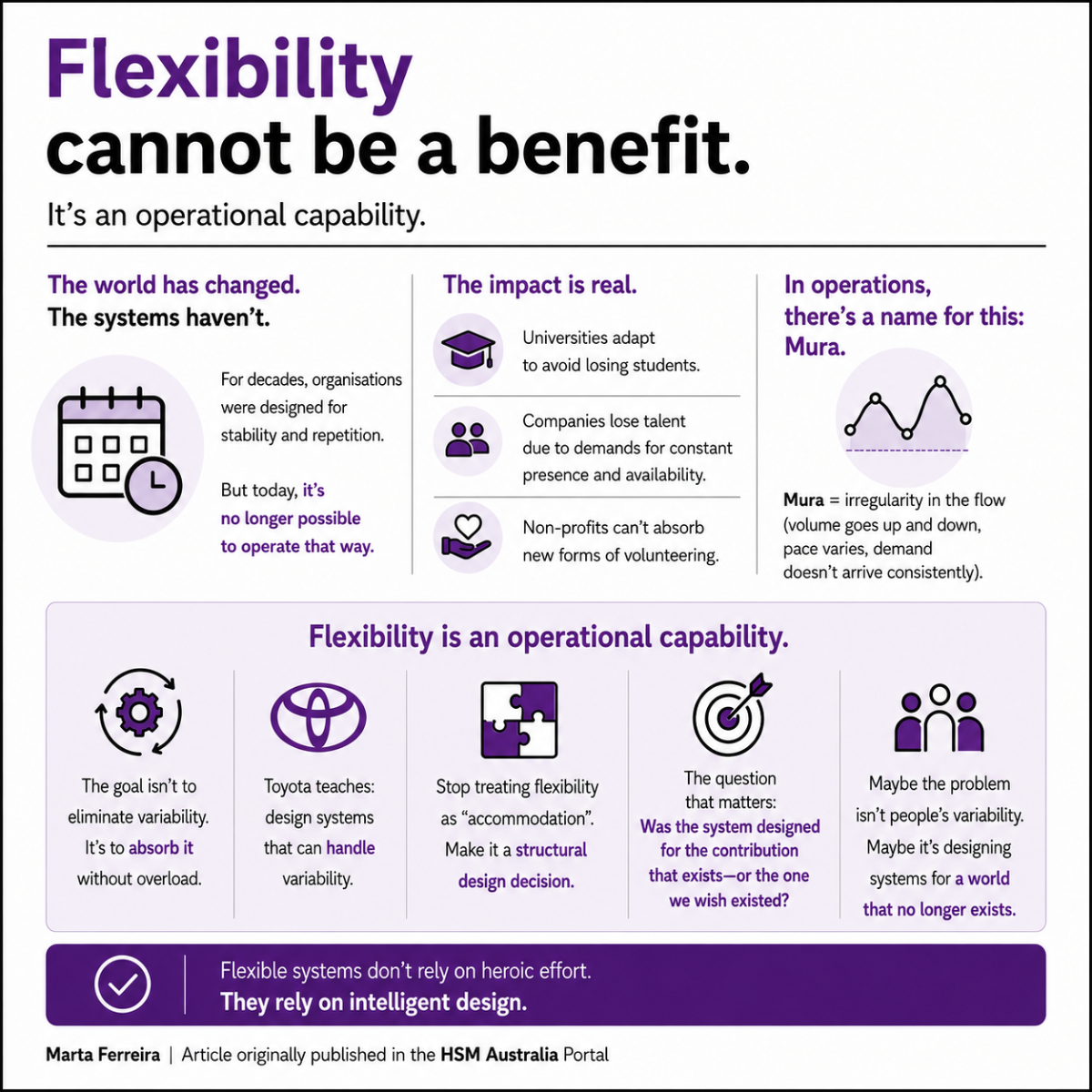
What if the problem is not people’s lack of commitment, but organizations’ inability to absorb the way people actually work today?
For decades, organizations were designed for stability: fixed schedules, linear career paths, continuous presence, and predictable availability. The problem is that the world no longer operates that way. Today, talent, learning, and even the willingness to contribute appear in less linear, more irregular, and less predictable ways. They still exist but no longer fit neatly into systems designed for repetition.
And this is becoming visible everywhere: universities are trying to adapt to avoid losing students; companies are losing talent because work models are still designed around physical presence and constant availability; and even non-profit organizations are discovering that they can no longer absorb new forms of volunteering.

When the willingness exists, but the model doesn’t
A non-profit organization wants younger volunteers. It advertises for them. But in practice, it rejects them because they can only show up for two hours on Tuesday afternoons, disappear during exam periods, and return in July. The structure was built for weekly, consistent, long-term participation. That volunteer does exist. They are 60 years old and have free time. The young volunteer with two irregular hours does not fit the model.
The willingness to contribute exists. The structure was not designed to absorb it.
According to a 2024 study by the Charities Aid Foundation, 68% of potential volunteers say they cannot commit due to their lack of continuous available time, not for their lack of willingness. The Stanford Social Innovation Review also reported that more than 30% of non-profits face operational difficulties precisely because of rigid volunteering models that exclude people with irregular availability.
This problem is not new. In operations management, there is a name for this type of tension: Mura.
Not all variability disappears
In the Toyota Production System, now widely adopted as a management reference across industries, Mura refers to irregularity in flow: volumes rising and falling, pace fluctuating, and demand arriving inconsistently. The conventional response is to level the flow, reduce irregularities, and create enough capacity to absorb variation without generating waste or overload.
This logic is highly effective in physical production environments, where reducing variability improves predictability, flow, and efficiency. The problem begins when the same logic is applied to human systems without distinguishing operational variability from human variability. There is an important difference between variability that the system can absorb and variability that ends up being transferred onto people.
When that happens, it has another name: Muri. Overload. The human effort that compensates for what the system failed to absorb.
Muri is what burnout measures. Muri is what the customer experiences when an employee is solving three problems at once. Muri is what happens when the only person who knows how to run a critical process goes on leave and the entire operation stalls.
We did not eliminate Mura. We created Muri.
The “ideal human resource” no longer exists
In the corporate world, the pattern is clear. According to FlexJobs, three out of four employees would consider leaving if flexibility disappeared. In 2024, 80% of companies reported already losing talent due to the return-to-office mandates. And remote or hybrid jobs, which represent only 20% of listings on LinkedIn, receive 60% of applications.
The system was designed for the ideal employee: full-time, on-site, and constantly available. The real employee is talented, willing to contribute, but only able to work three days a week or remotely, no longer fits. And they move to wherever they do fit.
The cost does not appear as a line item in the budget. It appears in turnover, endless recruitment cycles, and institutional knowledge walking out the door.
Flexibility is operational capability
If variability is already part of reality, then flexibility can no longer be treated as an exception, a perk, or an optional policy. It becomes an operational capability.
Absorbing Mura does not mean accepting chaos. It means designing systems that work with real contribution, not idealized contribution.
What I learned from Toyota is that the goal was never to eliminate all variability. It was to design systems capable of absorbing it without generating overload.
That requires us to stop thinking about flexibility as “accommodation” and start treating it as a structural operational design decision.
The clearest example I have seen was implemented in a C-level role at an insurance company in Australia. The Head of Department position was split between two part-time leaders with complementary behavioral profiles. The role was redesigned around the actual capacity available and the combination of capabilities required: one leader with a strong analytical orientation and the other focused on relationships and people. The system stopped depending on a single full-time individual and began operating with variability embedded into the design itself.
It was not a flexibility policy. It was an architectural decision.
This logic can take many forms: part-time contracts, time-banking systems, teams built around complementary strengths, flexible benefits tailored to individual realities, or modular learning pathways. The principle remains the same: design systems around real available capacity, not around a single model of presence and availability.
The same principle is emerging in other contexts: universities that recognize micro-credentials allow students with non-linear lives to accumulate meaningful capabilities without abandoning pathways that no longer fit into five uninterrupted years. Non-profits that create hourly volunteering packages can capture contributions that were previously wasted.
In every case, the variability already existed. What changed was the system’s ability to absorb it.
The question worth asking
Before concluding that people lack commitment, that talent is scarce, or that irregularity reflects a lack of discipline, it is worth asking: was the system designed for the contribution that actually exists, or for the contribution we wish existed?
Systems that try to eliminate Mura by force do not become more efficient. They become more fragile. And more dependent on people compensating for what the system cannot absorb, until they no longer can.
Perhaps the problem is not people’s variability. Perhaps the problem is that we are still designing systems for a world that no longer exists.
Inspired by an idea often attributed to Charles Darwin:
“It is not the strongest or the most intelligent who survive, but those most able to adapt to change.”
Associated Infogram