Mandatory return-to-office policies are often presented as the answer to management, collaboration, and productivity challenges. But they raise an important question: do high-performing organizations manage people by where they work, or by the value they deliver?
Imagine a bank that realizes it can no longer properly track transactions made through its app. Instead of fixing its systems, it shuts down the app, disables instant payments, and forces all customers back into branches to fill out paper checks and request printed statements.
The reaction would be immediate. No one would accept replacing a more efficient solution with a slower process simply because the organization is unable to monitor it properly.
Yet this is precisely the logic that appears—often in a more subtle form—in many discussions about mandatory returns to the office.

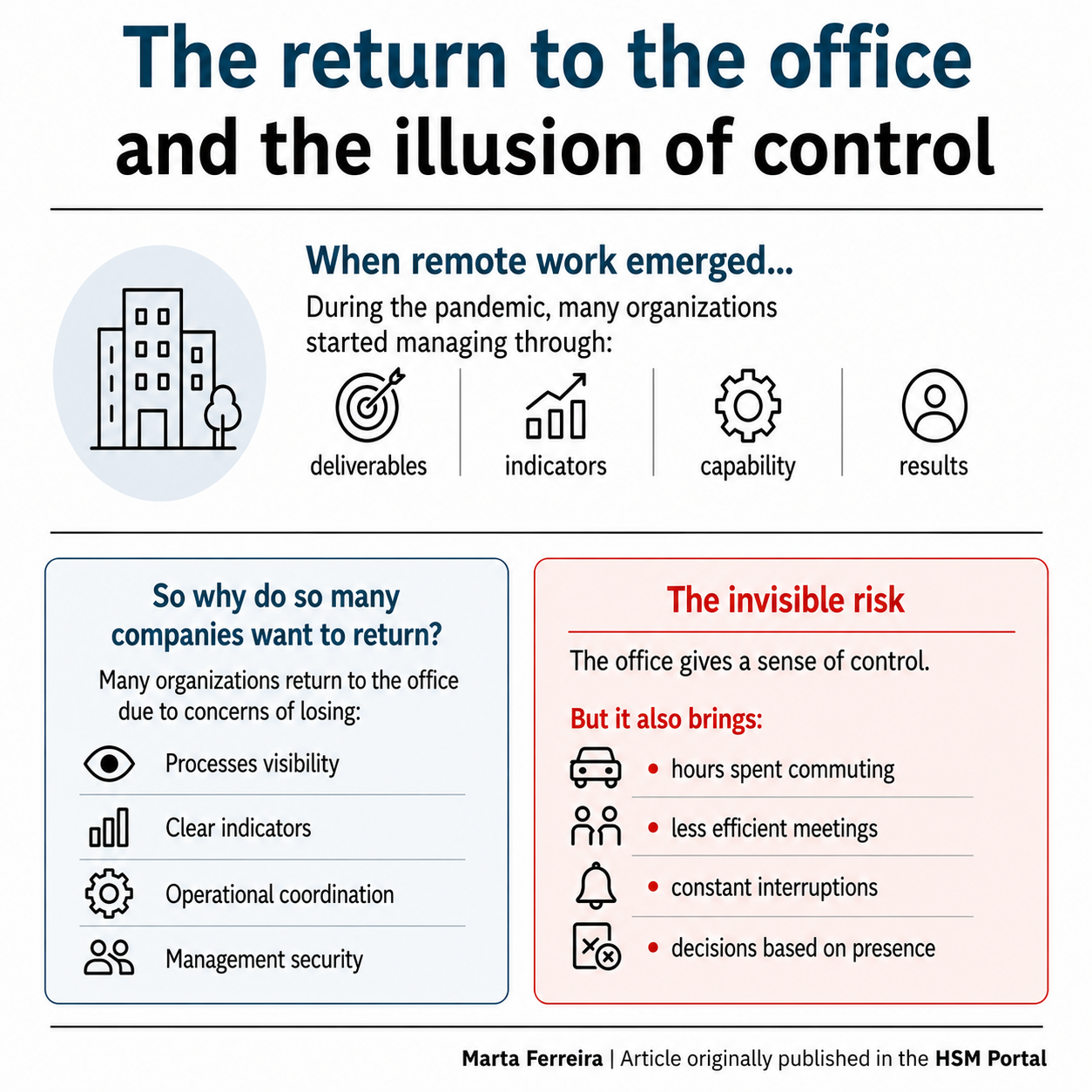
During the pandemic, remote work forced companies to do something many had been postponing for years: make work visible without relying on physical presence or paper trails. Without the reference of being in the office, organizations had to define deliverables, create indicators, size capacity, and establish clearer ways to measure outcomes.
This visibility had a positive side effect: it gave professionals greater autonomy to organize their time, pick up their children from school, and work during their most productive hours. Control shifted away from clocking hours and toward actual delivery.
However, many organizations are now pushing for a return to the office without redesigning how work actually happens. Much of the intelligence built during the pandemic is being discarded. When clear mechanisms for tracking and coordinating work are missing, the response is to bring work back to where it has always been: the physical office.
The logic of centralized management then collides with reality. Teams continue attending the same meetings, now in person. Along with them, inefficiencies that once seemed to have been eliminated return: time lost waiting for late arrivals, parallel conversations, and interruptions that add no real value. Physical presence starts to replace clear performance indicators.
The Global Return-to-Office Movement and the Search for Control
This retreat is not an isolated phenomenon. Major Wall Street banks such as Goldman Sachs and JPMorgan Chase have led aggressive moves to restore full five-day office mandates, framing the shift as a return to culture. The most common argument is the strengthening of organizational culture and team cohesion.
A global survey by KPMG, covering more than 1,300 executives, indicates that around 80% of CEOs plan to fully return to in-office models by 2027.
However, the data tells a more complex story. Studies led by Nicholas Bloom at Stanford University show that well-designed flexible work models can increase productivity by 13% to 20% and reduce voluntary turnover by up to 33%.
But when this shift reaches Brazil, it runs into a significant infrastructure gap. A survey by WeWork in partnership with Offerwise indicates that around 63% of Brazilian professionals are already in fully in-office roles, with most reporting that this arrangement is imposed by their employer rather than chosen for efficiency.
Unlike in Europe, workers in major Brazilian cities spend on average between 1.5 and 3 hours per day commuting, according to mobility data reported by G1. Consuming that much time and cognitive energy without a clear operational gain points to a fundamental design flaw in how work is structured. When a model requires more time, more energy, and more cognitive capacity to deliver the same outcome, it becomes difficult to argue that it is the most efficient choice.
The Invisible Inefficiencies
Why are companies moving back? In many cases, it comes down to the difficulty of managing work flows asynchronously.
Another common argument is that productivity and operational discipline are harder to ensure in remote settings.
It is important to take a fair view of managers. Many operate under strong pressure for results and lose visibility of processes when teams are not physically present. Without mature monitoring mechanisms, the natural reaction is to revert to traditional models. They return to what they know and have successfully managed for years: physical presence.
Physical presence creates a sense of control that does not always match operational reality.
The great irony is that the office environment often acts as an organizational anesthetic. Before the pandemic, many inefficiencies were normalized and absorbed into the cost of doing business. Remote work simply made this waste visible.
To assess the real efficiency of returning to the office, consider three simple flow-of-value tests:
The Useful Commute: Calculate the monthly hours teams spend in traffic. How many hours of high cognitive performance are burned simply to move people from one screen to another?
Meeting Waste: Measure time lost due to late starts, side conversations, and physical movement between rooms. Did that time create real value?
Fragmented Attention: Track the impact of constant micro-interruptions—colleagues stopping by for “quick questions,” corridor discussions about recent emails, or ambient noise. Classic research from the University of California, Irvine shows it can take more than 20 minutes to regain deep focus after a single interruption. In poorly structured in-office environments, this capacity for deep work is continuously eroded.
Less Proximity, More Governance
The fragility of mandatory office returns is not about physical presence itself. It is about attempting to replace management systems with proximity.
When indicators, processes, and clearly defined responsibilities are missing, visibility of people creates the illusion of control. But perception is not governance.
High-performing organizations do not manage presence. They manage flow of value. When that flow is properly designed, outcomes become consistent—regardless of the geographical location of those doing the work.
Associated Infogram