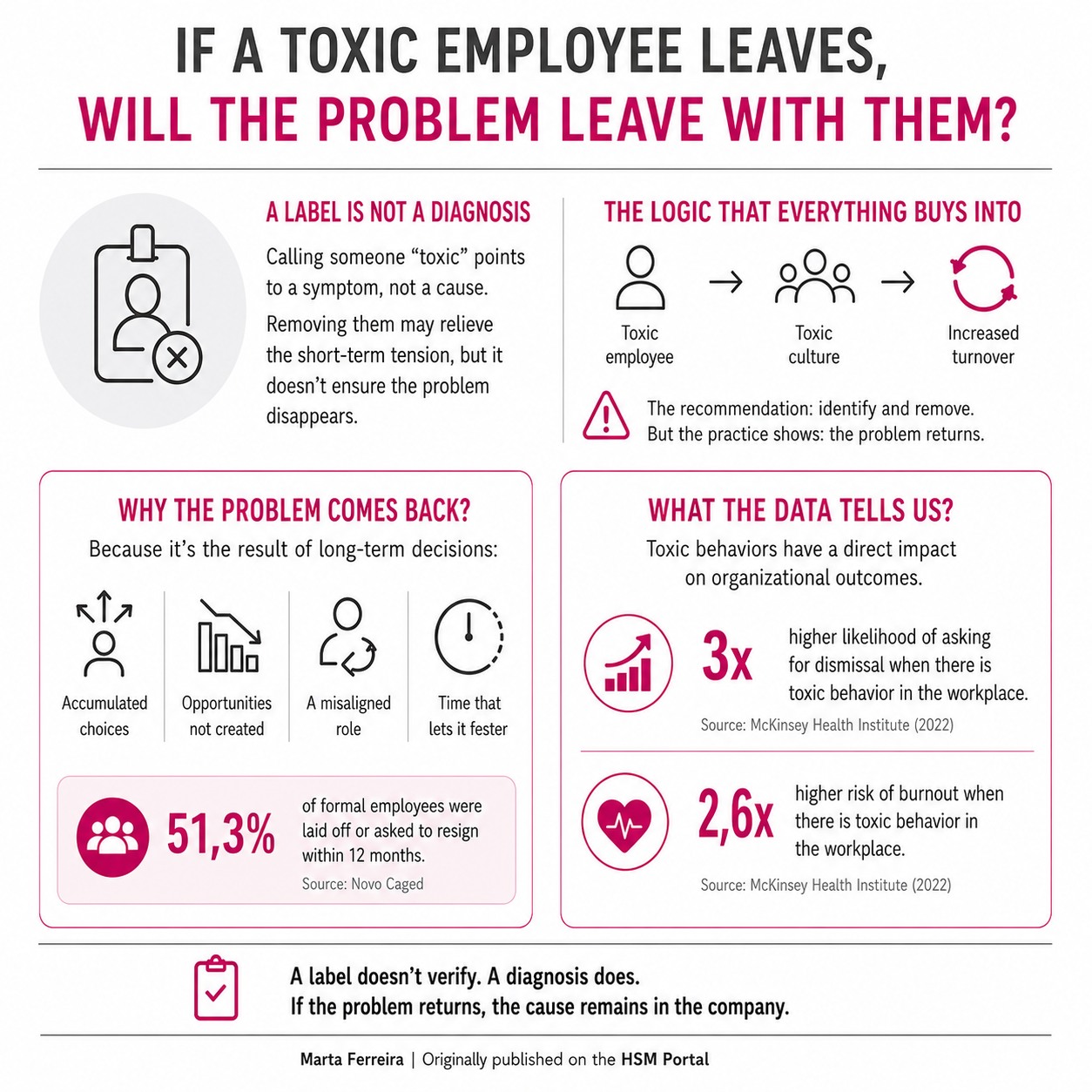
Labeling professionals as toxic may shut down a conversation, but it rarely solves the problem.
They’ve been with the company for eighteen years.
They’ve lived through four restructurings, six managers, and three transformation programs that arrived with branded T-shirts and disappeared before the next quarter.
Whenever someone needs to know why a particular client exception was approved back in 2019, they go to them. They’re the department’s walking encyclopedia—the keeper of rules no one ever bothered to document.
They’re also the person who says, “We’ve tried that before. It didn’t work,” before anyone has even finished the sentence.

In hallway conversations, they’re described as someone who drags the team down. Someone who arrives drained and takes the energy out of everyone else.
After so many years with the company, firing them would be costly. So the organization gradually narrows their scope: one project removed here, one report there. Eventually, they remain in a role no one formally designed. Their badge still works, but their career stopped moving forward years ago.
Organizations have a name for this kind of person: the toxic employee.
And that label carries an assumption that is rarely examined: that the person simply arrived that way.
The logic everyone buys into
At a business event, a speaker presented a simple chain of reasoning to a room full of university students:
Toxic employee → toxic culture → higher turnover.
The next slide offered the solution: Identify and remove.
The logic is clean: it fits neatly into three boxes, and everyone writes it down. The problem lies in what the model promises without ever saying it explicitly. If the relationship really works that way, removing the person should solve the problem: the employee leaves, the culture recovers, and turnover falls.
But that is often not what happens. A year and a half later, someone else occupies the same role in the team’s narrative. Sometimes they are literally sitting in the same chair, with the same reduced scope and the same reputation. And yet the same neat chain of logic continues to appear on conference stages as if it had already been tested and proven somewhere.
Does finding the culprit solve the problem?
In process engineering, a root cause is not simply an opinion about where a problem began. It is a hypothesis that must be tested. You remove the suspected cause and observe what happens. If the failure returns, then the thing you removed was not the root cause. It was either a symptom, or one layer below the real cause.
This seems obvious when we are dealing with machines. Replace a bearing, and the shaft seizes again three weeks later? Then the bearing was not the problem. No one argues about that. With people, however, the same test is rarely applied. The case is considered closed the moment someone leaves the organization. There is no review six months later. No follow-up eighteen months later.
When the same pattern of behavior reappears in the same team, and often in the same role, no one necessarily connects it to what happened before. The previous case has already been filed away as “resolved”. This is where the conversation about the “toxic employee” differs from almost every other discussion about organizational failure.
A label is not a diagnosis.
A diagnosis can be confirmed or disproved by the evidence that follows. A label has no such obligation, and that is precisely why it is so rarely challenged.
What actually fits inside the word “toxic”?
In Brazil, this conversation often appears under different names: workplace bullying, toxic leadership, toxic work environments, abusive behavior. The distinction matters because these terms do not all describe the same phenomenon.
A study involving 647 Brazilian healthcare professionals found that 22.41% reported experiencing workplace bullying during the previous year. The consequences included effects on health, professional performance, and the organization itself, including turnover, absenteeism, and workplace errors.
None of this suggests that destructive behaviors do not exist. They do, and their consequences can be measured. The problem begins when very different behaviors are grouped under a single label, and that label gradually becomes a diagnosis of the person.
Research from the McKinsey Health Institute helps separate these issues. Between February and April 2022, the study surveyed approximately 15,000 employees and 1,000 HR professionals across 15 countries, including Brazil. It examined factors such as toxic workplace behavior, workload, inclusion, belonging, and leadership commitment.
Across all countries surveyed, toxic behavior was the factor most strongly associated with burnout symptoms and employees’ intention to leave. The definition used in the study is particularly revealing. Toxic behavior included:
- unfair or degrading treatment;
- non-inclusive behavior;
- sabotage;
- destructive competition;
- abusive management; and
- unethical conduct.
These are six different things, none of them is a personality trait, all of them happen between people, within a particular environment. That changes the question.
Instead of asking “who is this person?”, we begin asking “what changed?”. Was it the person? The role? The context? Or the relationship between all three?
Investigating a cause is one thing. Naming a culprit is another, and it is much faster.
How does someone get to that point?
What is missing from this conversation is the mechanism. No one is hired with eighteen years of history already behind them. The behavior that appears in today’s performance review may have been shaped by a long sequence of decisions, each of which seemed perfectly reasonable at the time: a promotion went to someone else, for understandable reasons; an external candidate was hired because the deadline was tight; a development program made it into the budget and disappeared during the next review; someone was reassigned to a role that did not suit their profile during a rushed restructuring; a new initiative arrived with enthusiasm and was never repeated.
None of these decisions is necessarily scandalous. Some may have been made by managers who have since left the company. But accumulated over a decade, they become a history. The behavior that now causes frustration may be a record of that history rather than its original source.
Time is also becoming a more important factor: according to Brazil’s Continuous National Household Sample Survey (PNAD Contínua), the share of the population aged 60 and over increased from 11.3% in 2012 to 16.6% in 2025. Projections based on the survey’s microdata suggest that the average age of the workforce could rise from 38.8 in 2022 to 42.1 by 2060, while the share of workers aged 50 and over could grow from 22.4% to nearly one-third.
Long careers within the same organization are becoming less of an exception. That changes the nature of the challenge. Rather than waiting for a gap between a person’s capabilities and their role to surface as problematic behavior, organizations can monitor and support capability throughout the entire employee lifecycle.
Some operations already treat this as a measurement system rather than a labeling exercise:
- They use periodic capability assessments to help reposition people into roles that better match their current abilities;
- They invest in continuous learning throughout an employee’s career, rather than concentrating development at the beginning;
- They bring retired specialists back as instructors, turning accumulated knowledge into a training resource instead of allowing it to become organizational dead weight.
None of this depends on a particular philosophy about people. It depends on whether the organization has a mechanism capable of recognizing a mismatch before it turns into behavior.
Explaining is not excusing
There are cases where organizational diagnosis is not the point. Harassment, fraud, and violence require consequences, and removal may be the right response. Understanding how someone arrived at a particular behavior does not mean excusing that behavior.
According to Brazil’s Novo Caged data, 51.3% of formal workers were either dismissed or resigned within a twelve-month period. In a labor market where organizations replace roughly half of their workforce every year, removing someone is often the path of least resistance.
It is also the approach that teaches the organization the least: nothing is recorded about what produced the behavior in the first place, and the company enters the next replacement cycle with essentially the same information it had before.
And what if the problem comes back?
A diagnosis can be wrong. The good news is that there is a way to find out. Remove the suspected cause, then look again a few months later.
If one person leaves and the same behavior reappears in the same role, what exactly was removed? The cause, or simply the person occupying the position? The question applies equally to a bearing, an approval workflow, or a decision involving people.
A label offers no such test as it closes the case the moment it is applied and takes no responsibility for what happens afterward.
The distinction is technical, not rhetorical and when the diagnosis is wrong, a person walks out the door, while the cause remains inside the company.
Associated Infogram