A seemingly simple test conducted at a Japanese factory reveals why some organizations find talent where others see only a lack of experience.
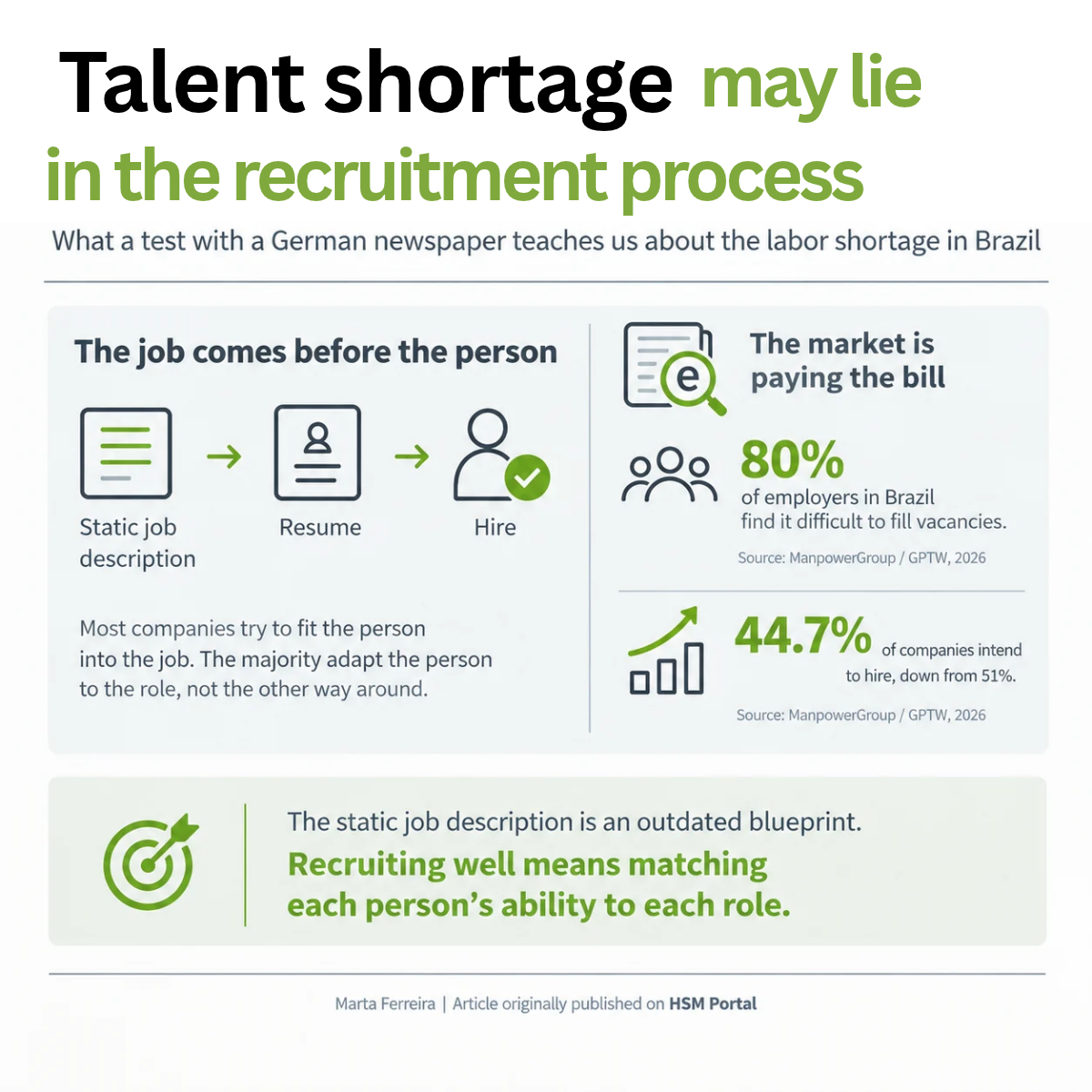
Most companies start with the job vacancy and try to fit a person into it.
At Yazaki in Japan, the logic ran the other way around. Demand on the shop floor was already mapped, but nobody got placed anywhere until the company had measured the candidate’s real aptitudes.
While most companies rebrand job titles to attract talent, the companies with the best practices match what the process needs to what each person does best. Picking people for a rigid role is buying the frame before the painting.

The test that wasn’t looking for “the best”
At Yazaki’s selection center in Japan, one of the first tests looked trivial: finding the letter “E” a hundred times on a page of a German newspaper, as fast as you can. The language didn’t matter, since nobody spoke German. The test cancelled out prior knowledge and measured only visual scanning speed and accuracy.
Candidates splitted in two:
- One, scanners quickly by sampling and skipped paragraphs to beat the clock.
- The other went line by line, with method.
There was no winner, rather a logic selection process based on natural aptitude: the methodical ones went to areas that call for rigor and detail, such as quality control, and the fast ones went to the production line or to order picking. The test was there to find out where in the operation each person would perform best.
The illusion of traditional screening
In most organizations the process runs the opposite way: someone opens a staffing request, HR pulls a static job description out of the archive, a recruiter filters résumés by keyword, and the interview checks the candidate’s past. The company is looking for someone identical to the document.
The market pays for that filter: the 8th edition of GPTW’s Trends in People Management report surveyed more than 1,300 professionals in Brazil, and hiring intentions fell from 51% to 44.7%. In ManpowerGroup’s 2026 Global Talent Shortage Survey, 80% of employers in Brazil say they struggle to fill positions, and lack of skills is the reason they cite most.
In many technical roles the shortage is real, but a good part of it comes out of the screening filter itself. When selection only recognizes people who have held the same job somewhere else, it throws out the fast learners and the quick adapters before the first conversation. Then the company complains it can’t find anyone.
The traditional job description tends to fail in one of two ways. Either it is an outdated copy of the real routine, or it turns into the manager’s unrealistic wish list. Asking for “Excel proficiency” or “ten years of management” says very little about the daily work. Without knowing what the operation actually demands, a good hire comes down to luck.
Measuring aptitude before reading the résumé
The method used in Japan started from a different premise: measure cognitive ability, problem-solving and real physical limitations before looking at the résumé or tying the candidate to a fixed position.
The tests lasted two or three days and varied a lot with the level of the role. For example: for operational jobs there were physical simulations, such as a board with 30 holes where candidates fitted pins against the clock. Anyone who started from the left got corrected. Halfway through, their arm would be passing over the pins already in place, and that costs time and raises the risk of error. The right way? Work from the center out to the edges, with both arms covering the same reach.
For engineering positions the board gave way to real problems from the shop floor. The candidate walked into a room with assessors from several specialties and got a practical challenge: “Our operation rejected this part. Can you tell us why?”
Each assessor watched for something different:
- Physical posture and how familiar the candidate looked handling the part, which shows who has actually worked a line;
- The approach to root-cause investigation: did the engineer only examine the part, or ask structured questions about the process, and what data did they ask for;
- Clarity of reasoning, how well organized their speech was, and technical command when speaking English.
Spotting limitations, such as color blindness in front of the Andon system’s lights, was never used to discriminate against or eliminate anyone. The measurement had two purposes:
- The first, was to protect the worker. Nobody went to a station where they were more likely to fail;
- The second was to protect the customer’s experience. No operational risk could be allowed to reach the end of the chain.
A case in Brazil shows what this logic produces. An automaker based in the interior of São Paulo state recruited farm workers for industrial painting. Selection looked for aptitude, not experience in the job. After training, those operators reached quality scores that put them among the group’s best painters worldwide. Under traditional résumé screening, not one of them would have made it through.
Where work manuals come from
For this to work without turning into bureaucracy, the company splits its documentation in two:
- Hiring documents are generic – They state only the level of responsibility and who the person reports to. That keeps the structure flexible, and people can move between areas without red tape or renegotiation;
- The detail of the work, the instructions for how a task gets done day to day, doesn’t come from HR to fill a vacancy. It is born with the product or service. Picture an insurer launching a new policy. When the policy is designed, so are the routines for the people who will sell it, assess it and handle the customers. If the service rules change, the manual changes with them. Employees don’t need a job description sitting in a drawer. They need an up-to-date operating manual.
And instead of rushing to the market every time someone leaves, these organizations recruit in waves (batch recruitment) a few times a year. They bring in people with a good attitude and general aptitudes that fit the company’s culture. Managers lose less time, selection costs less, and there are always people ready to be placed when demand shows up.
The same yardstick at the other end
Measuring aptitude to find the right place works for people already inside the company as much as for new arrivals.
The man who created Yazaki’s selection center started as a line operator himself. When his physical pace dropped, the company didn’t fire him. It had noticed he was unusually good at spotting waste and promoted him to supervisor. As a supervisor, he saw that gaps in initial training kept resurfacing further down the line. The selection and training method came out of that.
The same kind of adjustment rescued a bank’s call center in Australia. The best operators closed a sale in 7 minutes on average while one veteran took 21 minutes. He stretched the conversation out because he was still working by the old retention logic. Instead of firing him, the bank moved him: he went to the ombudsman team for complex cases, where listening calmly and in detail was exactly what the job asked for. He became the team’s best employee.
The static job opening is a bureaucratic shortcut: when a company doesn’t measure what a person does best on the way in, and doesn’t tie the role to the operation’s real rules, it spends years treating symptoms with subjective performance reviews.
Much of the talent shortage is a problem of how companies look. The market will keep complaining about a labor blackout for as long as it hunts for perfect people to fill imperfect job descriptions. Recruiting well means knowing where to send each person’s ability. The job comes after.
Associated Infogram