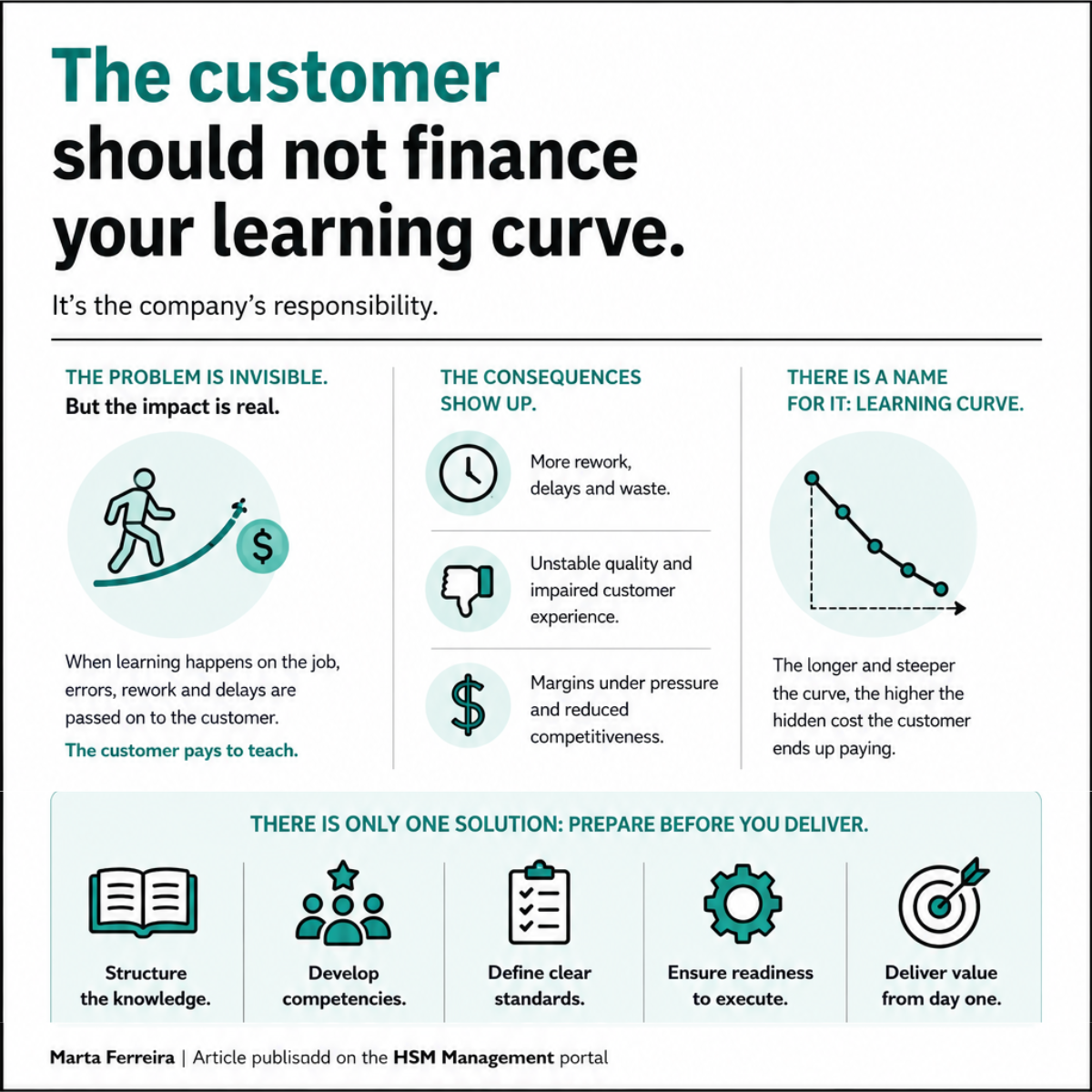
Starting from a simple everyday scene, this article highlights a recurring mistake in organizations: confusing training with true readiness and effectively shifting the learning curve onto the customer, with direct consequences for experience and business outcomes.
It’s Friday morning and you walk into your usual café, the one where they already know your name and start preparing your order almost as soon as you step through the door. It’s where you buy yourself ten minutes of quiet before heading to the office.
The following Monday, something feels different. There’s someone new behind the espresso machine.
You place your order, sit down, open your phone, and wait longer than usual.
When you glance back at the counter, you notice the new barista struggling to keep up with the stream of orders. The bench is disorganized, cups are piling up, and his movements feel uncertain. He wipes sweat from his forehead a few times before finally handing you your coffee, in a takeaway cup, even though you never order takeaway. You try it anyway.
It’s not good.

The issue there wasn’t a lack of effort or training. It was a lack of readiness.
And in practice, you were the one financing the learning curve of that hire.
For decades, this has been considered normal. New employees learn on the job. New support agents take real customer calls. New managers run real meetings. New analysts make real decisions. And customers directly absorb the cost of that learning curve.
But maybe it’s time to question why so many organizations still treat customers as a training environment.
The missing gap almost no one designs for
Companies invest millions in recruitment, retention, employer branding, and talent attraction. They talk about labor shortages, employee experience, and salary competitiveness.
At the same time, many still treat preparation for the job as a secondary concern.
There’s an unspoken assumption behind this: if someone is well-educated, experienced, and passed the hiring process, they should be able to perform quickly.
But qualification is not the same as execution capability.
Someone can understand concepts, tools, and processes and still not be ready to perform consistently in a real environment under pressure, in front of real customers.
What usually exists is administrative onboarding: system access, corporate presentations, internal policies, mandatory training modules, and some initial technical instruction.
All necessary, but incomplete.
Explaining the job is not the same as preparing someone to actually do it well.
The modern onboarding paradox
The data helps expose the mismatch.
According to Gallup research, only 12% of employees strongly agree their organization does onboarding well. At the same time, studies published in the Harvard Business Review show that it takes, on average, about eight months for new employees to reach full productivity.
Yet most organizations continue focusing on speeding up hiring cycles, digitizing learning paths, and automating onboarding processes.
Artificial intelligence is now playing a growing role in this space. And for good reason: AI can personalize content, identify knowledge gaps, automate administrative tasks, and make onboarding more efficient.
The problem is that many companies are still optimizing the wrong thing.
Because process efficiency does not, by itself, solve execution readiness.
Someone can complete every training module, pass internal assessments, and still struggle with the complexity of real work: exceptions, ambiguity, operational pressure, decision-making, and customer interaction.
The café barista likely knew, in theory, how to make an espresso.
The gap appeared when theory met reality at the counter.
The difference between knowing and being able to execute
Over the years, I’ve seen organizations approach this challenge in very different ways.
In some customer service operations, new hires start handling real customers after only a few hours of training and a script. In corporate environments, prior experience is assumed to automatically transfer into internal systems. In many industrial settings, training depends almost entirely on informal peer-to-peer learning.
The result is predictable: rework, inconsistency, constant supervision, and experienced employees compensating for gaps that should have been closed before anyone reaches the customer.
But there are organizations that operate differently.
During my time at Yazaki, a global supplier to the automotive industry, I came across a simple but powerful approach: no one interacted with the real product until they demonstrated the ability to perform the task to the required standard.
To make that possible, the company maintained a dojo, a training environment built with full replicas of the actual operation. Before entering the production line, new employees practiced repeatedly, received immediate feedback, corrected mistakes, and kept practicing until they reached the required rhythm and quality.
The goal was not to speed up entry into production. It was to prevent the learning curve from happening in front of the customer.
What the best operations have understood
This logic isn’t limited to manufacturing. Pilots train in simulators before carrying passengers. Surgeons practice techniques before entering an operating room. Disney invests heavily in preparing employees before they interact with guests.
There’s a shared principle underneath all of this: learning and serving the customer do not need to happen at the same time.
Yet outside of what we label as “critical” environments, many organizations still treat on-the-job learning as inevitable. And that may be part of the problem.
When people are placed into roles before they are truly ready, the cost doesn’t disappear, it simply moves.
It shifts to the customer, who receives an inconsistent experience.
It shifts to teams, who absorb rework.
It shifts to leaders, who end up permanently operating in correction and support mode.
And then we label the symptoms as separate problems: low productivity, recurring errors, excessive supervision, turnover, and execution gaps.
We rarely ask whether people were actually ready before being exposed to real work.
The question worth asking
For years, we’ve talked about talent, engagement, training, and retention. Maybe it’s time to add one more question: How many of the problems we attribute to people are actually the result of putting them into roles before they were ready to succeed?
Because hiring someone is only the beginning of the cycle, not the end of their readiness.
Associated Infogram